
What Questions Should I Ask When Hiring a Bookkeeper for My Medical Practice?
Running a medical practice involves more financial complexity than many other businesses.
You aren't simply collecting payments and paying a few monthly expenses.
Your practice may be managing:
Patient payments
Insurance reimbursements
Provider and staff payroll
Independent contractors
Medical equipment
Clinical supplies
Practice management software
Insurance
Facility expenses
Compliance-related costs
Professional services
As the practice grows, keeping all of this financial activity organized becomes increasingly important.
That's why choosing a bookkeeper for a medical practice shouldn't come down to price alone.
The better question is:
Can this bookkeeper give you the financial information you need to understand and manage your practice?
What Should You Look for in a Bookkeeper for a Medical Practice?
When hiring a bookkeeper, ask about more than whether they can categorize transactions.
You want to understand their experience, what their service includes, how frequently they review your accounts, what reports you'll receive, and how they communicate financial information.
Most importantly, you want bookkeeping that gives leadership greater visibility into what's happening financially.
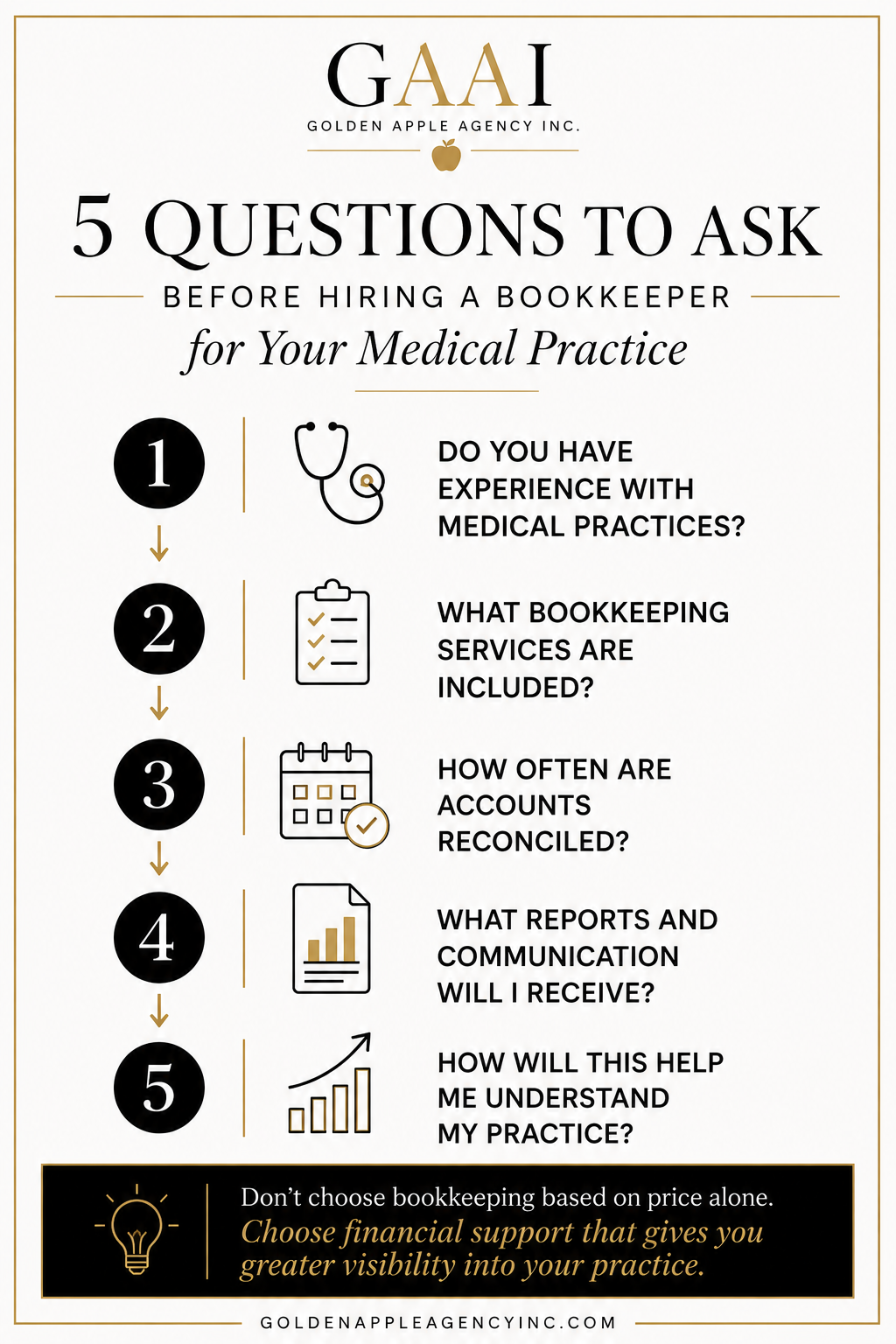
Here are five areas to discuss before choosing a bookkeeper for your medical practice.
1. Ask About Medical-Practice Experience
Start by asking whether the bookkeeper has experience working with medical practices or other healthcare businesses.
Healthcare businesses can have financial considerations that look different from those of many other industries.
Ask questions such as:
Have you worked with medical or healthcare practices?
What types of practices have you supported?
How do you organize different sources of practice revenue?
How do you handle payroll and contractor payments?
Are you familiar with common expenses within a medical practice?
Your bookkeeper doesn't need to make clinical or operational decisions.
But understanding how a healthcare business operates can make it easier to organize financial information in a way that's useful to the practice.
2. Understand Exactly What Services Are Included
"Bookkeeping" can mean very different things depending on the provider.
One bookkeeper may primarily categorize transactions.
Another may provide reconciliations, monthly financial reporting, account reviews, and ongoing communication.
Before signing an agreement, ask exactly what is included.
For example:
Transaction categorization
Bank reconciliations
Credit card reconciliations
Financial reporting
Payroll coordination
Contractor tracking
Account review
Cleanup work
Tax-ready financial records
Ongoing support
You should also understand what isn't included.
This makes it easier to compare providers based on the actual level of support rather than comparing prices for services that aren't equivalent.
3. Ask How Often Accounts Are Reconciled
Reconciliation is one of the foundations of accurate bookkeeping.
It compares the transactions recorded in your bookkeeping system with activity in your actual bank and credit card accounts.
Ask:
How often will my accounts be reconciled?
For an active medical practice, waiting months to reconcile accounts can allow problems to go unnoticed.
Regular reconciliation can help identify issues such as:
Missing transactions
Duplicate entries
Incorrect balances
Unrecorded expenses
Categorization problems
Accurate reports depend on accurate underlying records.
If the books haven't been properly reconciled, leadership may be making decisions based on incomplete or incorrect information.
4. Review the Reporting and Communication Process
Getting financial reports is one thing.
Understanding them is another.
Ask what reports you'll receive, how often you'll receive them, and whether someone will help you understand what you're looking at.
At minimum, practice leadership should have visibility into important financial areas such as:
Revenue
Expenses
Profitability
Cash flow
Payroll costs
Major overhead expenses
Changes in financial performance
Also ask how communication works.
Will you have a point of contact?
Can you ask questions throughout the month?
Will someone flag unusual activity?
How often will you discuss financial performance?
Good bookkeeping shouldn't leave you with reports you never open because you don't know what they mean.
5. Ask How They Support Growth and Financial Visibility
This question becomes especially important for an established or growing medical practice.
Ask:
How will your bookkeeping help me understand the financial performance of my practice?
Accurate bookkeeping is the starting point.
But as a business becomes more complex, leadership needs financial information that can support decisions.
For example, your numbers may help you evaluate questions such as:
Can the practice afford another employee?
Is overhead increasing faster than revenue?
Are payroll costs sustainable?
Is the practice becoming more profitable as revenue grows?
Does the business have enough cash to make a major investment?
Which expenses deserve closer attention?
A bookkeeper isn't necessarily responsible for making these decisions.
But your bookkeeping system should provide accurate information that helps you evaluate them.
Basic Bookkeeper vs. Practice-Focused Bookkeeper
Not every medical practice needs the same level of financial support.
However, it's important to understand the difference between basic transaction management and bookkeeping designed around the financial needs of a growing practice.
Basic Bookkeeper
A basic bookkeeping service may:
Record transactions
Categorize expenses
Reconcile accounts
Provide standard reports
Offer limited strategic context
For a simple business, that may be enough.
But an established medical practice may need greater financial visibility.
Practice-Focused Bookkeeper
A more practice-focused service may:
Understand healthcare business operations
Track practice-specific expenses
Maintain consistently reconciled accounts
Provide useful financial reporting
Help identify financial issues earlier
Give leadership better financial visibility
Support more informed business decisions
The difference isn't simply how many bookkeeping tasks are completed.
It's how useful the resulting financial information is to the people running the practice.
Accurate Bookkeeping Is Only the Starting Point
Your financial reports are only as useful as the information behind them.
If transactions are missing, accounts aren't reconciled, or expenses are categorized incorrectly, your reports may not reflect the true financial position of the practice.
But accuracy alone isn't the end goal either.
A growing medical practice also needs to understand:
Profitability.
Are you actually keeping more as the practice grows?
Cash flow.
Does the practice have enough cash available to meet obligations and fund future investments?
Overhead.
How much does it cost to operate the practice?
Performance.
Are your financial results improving, declining, or staying relatively flat?
These are leadership questions.
And answering them starts with having reliable financial information.
Don't Choose a Bookkeeper Based on Price Alone
Bookkeeping is an area where the lowest price doesn't always produce the lowest long-term cost.
Poor bookkeeping can create problems that eventually require cleanup, complicate tax preparation, reduce financial visibility, and make it harder to understand the performance of the practice.
Instead of asking only:
"How much does bookkeeping cost?"
Ask:
"What financial information and support will our practice receive?"
That shifts the conversation from cost to value.
Your Bookkeeping Should Help You Understand Your Practice
The right bookkeeping system should do more than keep transactions organized.
It should give leadership confidence that the financial information they're reviewing is accurate, current, and useful.
As your medical practice grows, that visibility becomes increasingly important.
Before hiring a bookkeeper, ask about their healthcare experience, services, reconciliation process, reporting, communication, and ability to support greater financial visibility.
Because better financial decisions start with better financial information.
Golden Apple Agency Inc. helps established businesses build stronger financial systems, improve visibility, and make more informed decisions as they grow.
