
Busy Practice. Flat Profit. The Hidden Problem
Many medical practices assume that seeing more patients automatically leads to higher profits.
But in reality, more volume does not always create better financial outcomes.
Many growing practices experience:
higher overhead
operational inefficiencies
staffing pressure
inconsistent profitability
As patient volume increases, financial inefficiencies often increase too.
That is why some practices stay extremely busy while profits remain flat.
Growth without financial visibility can quietly reduce margins over time.
Strong medical practices do not just focus on revenue.
They focus on profitability, efficiency, and operational structure.
The How-To Steps
1. Track Profit Per Patient
Many practice owners track:
appointments
collections
production
overall revenue
But fewer practices consistently track profitability per patient.
Without understanding:
service profitability
operational costs
provider efficiency
reimbursement patterns
it becomes difficult to identify where profit is actually being created.
Higher patient volume can sometimes increase:
staffing strain
scheduling inefficiencies
administrative costs
operational waste
without meaningfully improving profitability.
Revenue alone does not tell the full financial story.
Profitability tracking creates better operational decision-making.
2. Improve Financial Efficiency
As practices grow, financial inefficiencies often grow quietly alongside them.
Over time, this may include:
unnecessary software subscriptions
rising payroll costs
duplicated systems
inefficient workflows
operational waste
underperforming vendor relationships
Without consistent financial review, small inefficiencies can compound quickly.
Busy practices often become so focused on operations that financial oversight becomes reactive instead of intentional.
Improving financial efficiency helps practices:
identify financial leaks early
improve cash flow visibility
make cleaner budgeting decisions
protect long-term profitability
The most profitable practices are often not the busiest.
They are usually the most operationally organized.
3. Optimize Pricing and Practice Structure
Many practices continue operating with outdated pricing models long after demand increases.
As operational costs rise, pricing strategy becomes increasingly important.
This may involve reviewing:
reimbursement structures
service pricing
package profitability
provider utilization
operational capacity
The goal is not simply charging more.
The goal is creating a structure that supports:
healthy margins
operational sustainability
long-term growth
stronger financial predictability
Practices that grow without reviewing pricing and operational structure often create more work without increasing profitability.
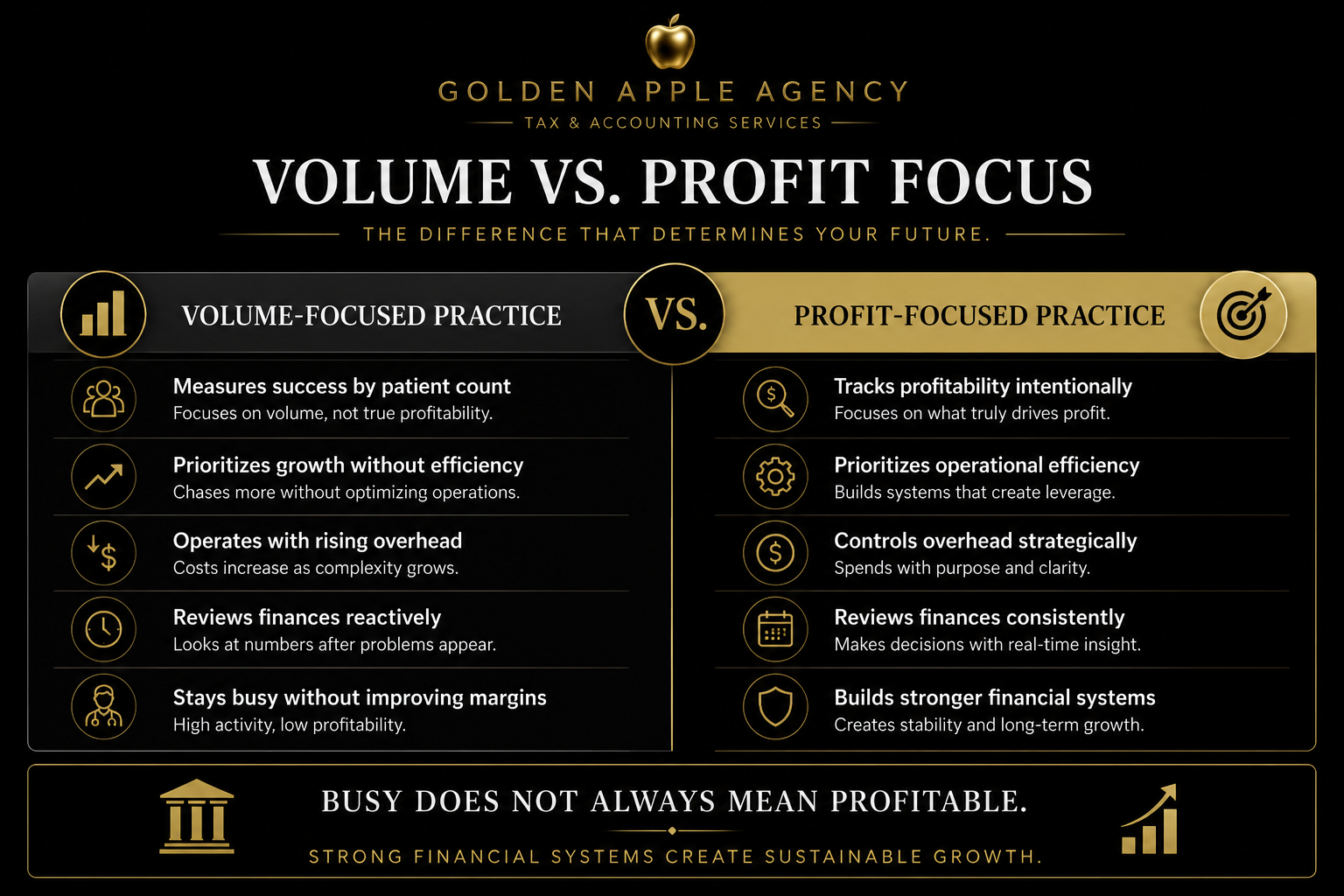
The Comparison
Volume-Focused Practice
Measures success by patient count
Prioritizes growth without efficiency
Operates with rising overhead
Reviews finances reactively
Experiences inconsistent profitability
Stays busy without improving margins
Profit-Focused Practice
Tracks profitability intentionally
Prioritizes operational efficiency
Controls overhead strategically
Reviews finances consistently
Builds stronger financial systems
Increases long-term profitability
The Reality Check
A busy practice is not always a profitable practice.
More patients do not automatically create stronger financial outcomes.
If revenue is increasing but profit margins remain flat, the problem is usually not growth.
The problem is inefficiency.
Without financial visibility, practices often scale operational complexity faster than profitability.
The goal is not simply staying busy.
The goal is building a practice that operates efficiently, profitably, and sustainably.
Are You Growing Revenue — or Growing Profitability?
Strong financial systems create stronger long-term outcomes.
At Golden Apple Agency Inc., we help medical professionals and high-income business owners build financial systems designed to improve profitability, operational clarity, and long-term growth.
Because sustainable growth should increase profitability — not just workload.
