
Metrics Every Doctor Should Track in Their Medical Practice
A busy medical practice can look successful from the outside.
The schedule is full. Patients are being seen. Revenue is coming in. The team is constantly working.
But a busy practice is not always a financially healthy practice.
For physicians who own their practices, understanding performance requires looking beyond the number of patients walking through the door.
You need to know what the numbers behind the practice are telling you.
Because when you track the right metrics, you can identify financial problems earlier, make more informed decisions, and build a practice that is not only busy—but profitable and financially sustainable.
The Problem: Being Busy Does Not Tell You How Your Practice Is Performing
Many doctors spend years developing their clinical expertise.
But owning a medical practice also means running a business.
And the financial side of that business can become complicated quickly.
Payroll.
Medical supplies.
Equipment.
Insurance reimbursements.
Accounts receivable.
Facility expenses.
Taxes.
Administrative costs.
You may have a full patient schedule and strong revenue while still experiencing cash flow problems or declining profitability.
Without tracking the right metrics, it can be difficult to understand where the practice is actually making money—and where it may be losing it.
The Direct Answer: Doctors Need a Financial Scoreboard
You do not need to spend every day analyzing financial reports.
But as the owner of a medical practice, you should have a clear financial scoreboard that shows you how the business is performing.
The specific metrics will depend on your practice, specialty, and business model, but several numbers can provide valuable insight into your overall financial health.
The goal is not to track every number available.
The goal is to track the numbers that help you answer important questions:
Is the practice profitable?
Is cash flow healthy?
Are we collecting the money we are owed?
Are expenses growing too quickly?
Can we afford to hire or expand?
Are we prepared for our tax obligations?
When you can answer these questions, you can make decisions with greater clarity.
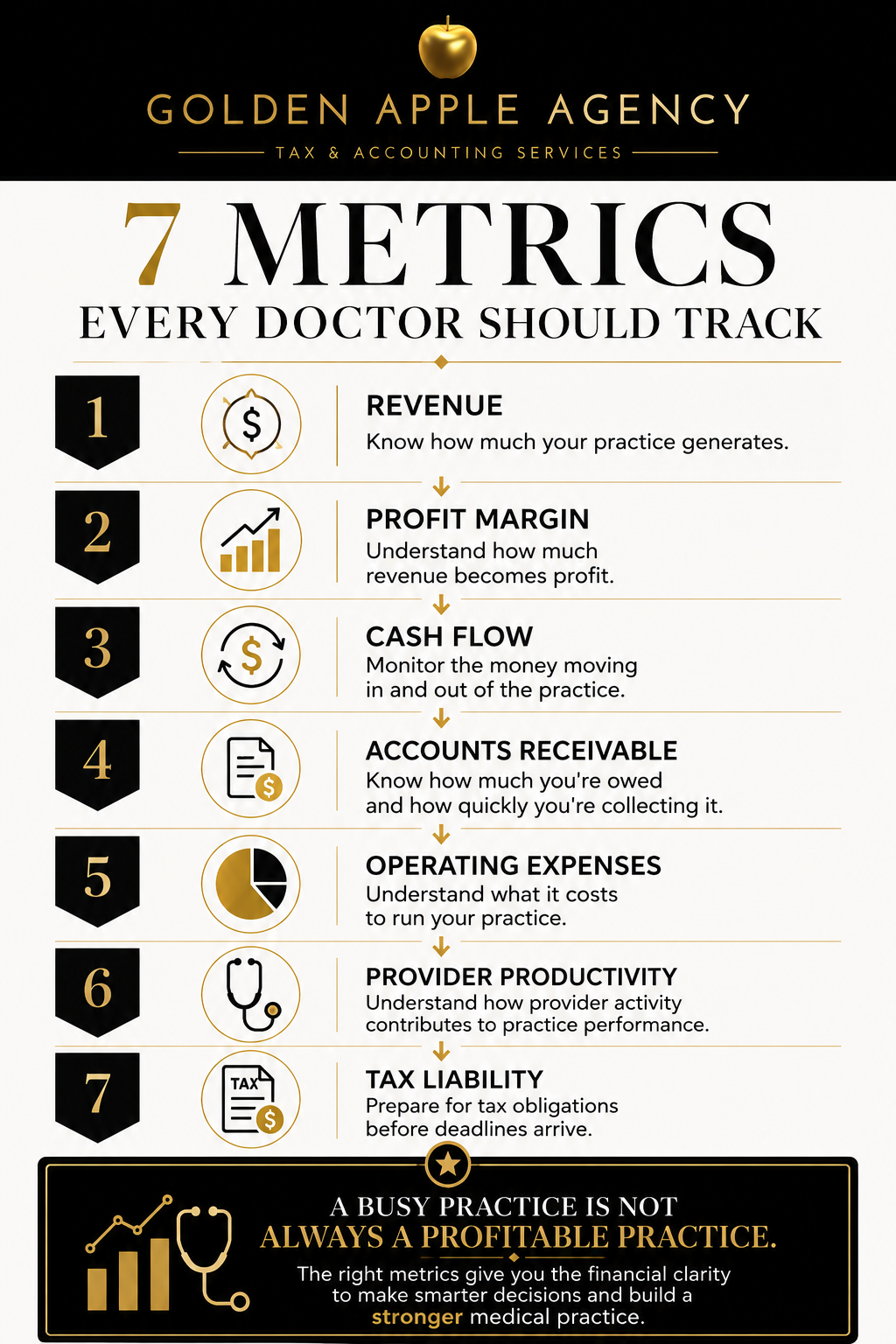
Seven Metrics Every Doctor Should Track
Step 1: Revenue
Revenue tells you how much money your practice generates.
Track revenue consistently and compare it over time.
Look at monthly, quarterly, and annual trends rather than focusing on one strong or weak month.
You may also want to evaluate revenue by provider, location, or service line when appropriate.
The goal is to understand not only how much revenue the practice generates, but where that revenue is coming from.
Step 2: Profit Margin
Revenue tells you what comes in.
Profitability helps you understand what remains after expenses.
A practice can increase revenue while becoming less profitable if payroll, supplies, overhead, or other costs increase faster than income.
Tracking profit margins helps you determine whether growth is actually improving the financial health of the practice.
Step 3: Cash Flow
A profitable practice can still experience cash flow problems.
Money may be tied up in accounts receivable while payroll, rent, equipment payments, and other expenses still need to be paid.
Monitoring cash flow helps you understand whether the practice has enough available cash to meet its obligations and invest in future opportunities.
Step 4: Accounts Receivable
Providing a service and collecting payment are two different things.
Tracking accounts receivable helps you understand how much money is owed to the practice and how long it is taking to collect.
If receivables continue to grow or payments take longer to arrive, the practice could experience cash flow pressure even when revenue appears strong.
Step 5: Operating Expenses
Every medical practice has overhead.
The important question is whether those expenses are growing at a sustainable rate.
Monitor major expense categories such as:
Payroll and staffing.
Rent and facility costs.
Medical supplies.
Equipment.
Technology and software.
Insurance.
Administrative expenses.
Understanding where your money goes makes it easier to identify unnecessary spending and protect profitability.
Step 6: Provider Productivity
For multi-provider practices, understanding productivity can provide important business insights.
Depending on the practice, this might include patient volume, collections, revenue generated, or other appropriate performance indicators.
The purpose is not simply to compare doctors.
It is to understand how staffing, scheduling, and provider capacity affect the financial performance of the practice.
Step 7: Tax Liability and Estimated Payments
Tax obligations should not be a surprise.
As practice income changes throughout the year, your potential tax liability can change with it.
Regular financial reporting and proactive tax planning can help practice owners prepare for estimated payments and identify potential planning opportunities before year-end.
Running a Practice Without Metrics vs. With Metrics
Without Clear Metrics:
A full schedule is treated as proof of financial success.
Revenue is tracked without understanding profitability.
Cash flow problems seem to appear unexpectedly.
Accounts receivable continues growing without enough attention.
Expenses increase without regular review.
Hiring and expansion decisions are based primarily on workload.
Tax obligations may come as a surprise.
With Clear Metrics:
Financial performance is measured consistently.
Revenue and profitability are reviewed together.
Cash flow is monitored and forecasted.
Accounts receivable trends are identified earlier.
Expenses are regularly evaluated.
Growth decisions are supported by financial information.
Tax planning becomes more proactive.
The difference is visibility.
You cannot improve what you cannot clearly see.
The Reality Check: High Revenue Does Not Guarantee a Profitable Practice
A medical practice can generate significant revenue and still have financial problems.
Consider a practice that increases annual revenue substantially.
On paper, the business appears to be growing.
But during the same period, the practice may have added employees, purchased equipment, increased marketing, expanded office space, and experienced higher supply costs.
Meanwhile, insurance reimbursements may take time to collect.
If expenses and cash demands increase faster than collections and profitability, the practice may actually become financially weaker while appearing more successful.
That is why revenue should never be viewed in isolation.
The bigger question is:
What is happening to the money after the practice earns it?
The Bigger Picture: Financial Metrics Help Doctors Make Better Business Decisions
Financial reporting should not exist simply to satisfy accounting requirements.
It should help you run your practice.
When you understand your numbers, you can make more informed decisions about:
Hiring another provider.
Adding staff.
Purchasing equipment.
Opening another location.
Expanding services.
Managing cash reserves.
Planning for taxes.
Improving profitability.
The stronger your financial visibility becomes, the easier it is to connect business decisions to their potential financial impact.
For established medical practices, this is where strategic accounting and financial advisory become especially valuable.
You are no longer simply asking what happened last year.
You are using financial information to decide what should happen next.
Do You Know What Your Practice's Numbers Are Telling You?
You know how many patients are on the schedule.
But do you know your profit margin?
Do you know how much money is sitting in accounts receivable?
Do you understand your monthly cash flow?
Do you know which expenses are increasing fastest?
Do you have a clear picture of your upcoming tax obligations?
If you cannot answer these questions quickly, your practice may be operating without the financial visibility needed to make confident strategic decisions.
At Golden Apple Agency Inc., we help established businesses understand the financial picture behind their operations and use those insights to make more informed decisions.
Because running a successful medical practice requires more than excellent patient care.
It requires knowing the numbers behind the business.
